APINDO Central Sulawesi: Freshwater Fisheries Should Be Developed into a New Economic Force
Tuesday, 22 September 2026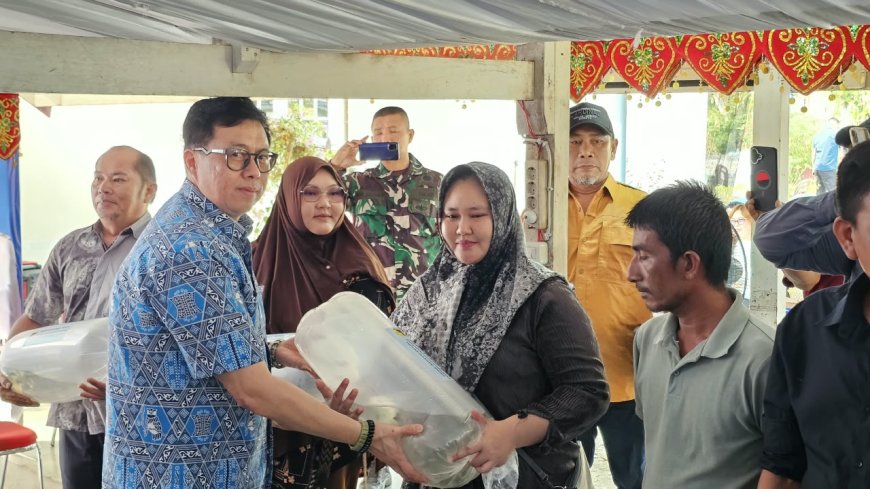
SIGI — Chairman of the Central Sulawesi Provincial Leadership Council of the Indonesian Employers Association (APINDO), Wijaya Chandra, described the distribution and handover of fish seed assistance in Sigi Regency as a positive step toward creating opportunities for collaboration among local communities, the government, and the business sector.
According to Wijaya, the freshwater fisheries sector has significant potential for further development, not only in aquaculture but also in business development, supply chains, processing, distribution, and marketing.
“We see activities like this as very positive because community empowerment cannot rely solely on providing assistance. There must be continuity from upstream to downstream — starting with fish seed, the cultivation process, and capacity building for fish farmers, through to ensuring that their products have access to markets and generate economic value,” Wijaya Chandra said on Friday, September 18, 2026.
He said the involvement of the business sector in developing fisheries could play an important role in strengthening local economic value chains.
According to Wijaya, fish-farming groups should be encouraged to move beyond a production-oriented approach and gradually develop businesses with better governance, production standards, and market access.
“This is where collaboration becomes important. The government has programs and policies, community groups have potential and resources, while the business sector can help open up market access and business development opportunities. If these strengths can be brought together, the impact will certainly be greater,” he said.
Wijaya also emphasized the importance of program sustainability. He said fish seed assistance should be viewed as an initial investment in community empowerment, rather than an end in itself.
He expressed hope that the initiative, organized by POKDAKAN Ikan Berkat Balkes Roviga in cooperation with P3D and the Central Sulawesi Provincial Marine and Fisheries Agency, could develop into a collaborative model involving a wider range of stakeholders.
“The process should not end after the fish seed are distributed. What matters more is how, over the coming months and years, the group can grow, increase production, establish clear markets, and generate greater economic benefits for the community,” he said.
More broadly, Wijaya said potential partnerships with the business sector could focus on developing the fisheries supply chain, including the provision of production facilities, business assistance, access to financing, product processing, and marketing.
The view is in line with APINDO Central Sulawesi’s role in promoting strategic communication between the government and business community through various public initiatives, as well as exploring opportunities for regional economic development. APINDO Central Sulawesi has also identified fisheries as one of the region’s economic sectors with potential for development through partnerships and improved market access.
Wijaya said he hoped the development of freshwater fisheries in Sigi could eventually be directed toward partnership models that benefit fish farmers while also creating opportunities for businesses.
“We are open to exploring potential opportunities like this. What matters is that the business model is clear, the group is ready, production can be properly accounted for, and there is continuity. From there, businesses will find it easier to identify potential areas for cooperation,” he said.
According to Wijaya, the success of an empowerment program should ultimately not be measured simply by how many fish seed are distributed, but by the ability of beneficiary groups to grow into independent and competitive business operators.
He expressed hope that the collaboration being developed in Sigi Regency would continue to be strengthened, enabling the freshwater fisheries sector to make a greater contribution to the regional economy.
“If we want the regional economy to grow, we need to turn the potential of local communities into tangible economic activities. Freshwater fisheries are one of the sectors that deserve to be developed seriously and sustainably,” he concluded.
Source: Metro Sulawesi