APINDO South Kalimantan Holds Economic Dialogue and 2nd Provincial Working Meeting
Saturday, 18 April 2026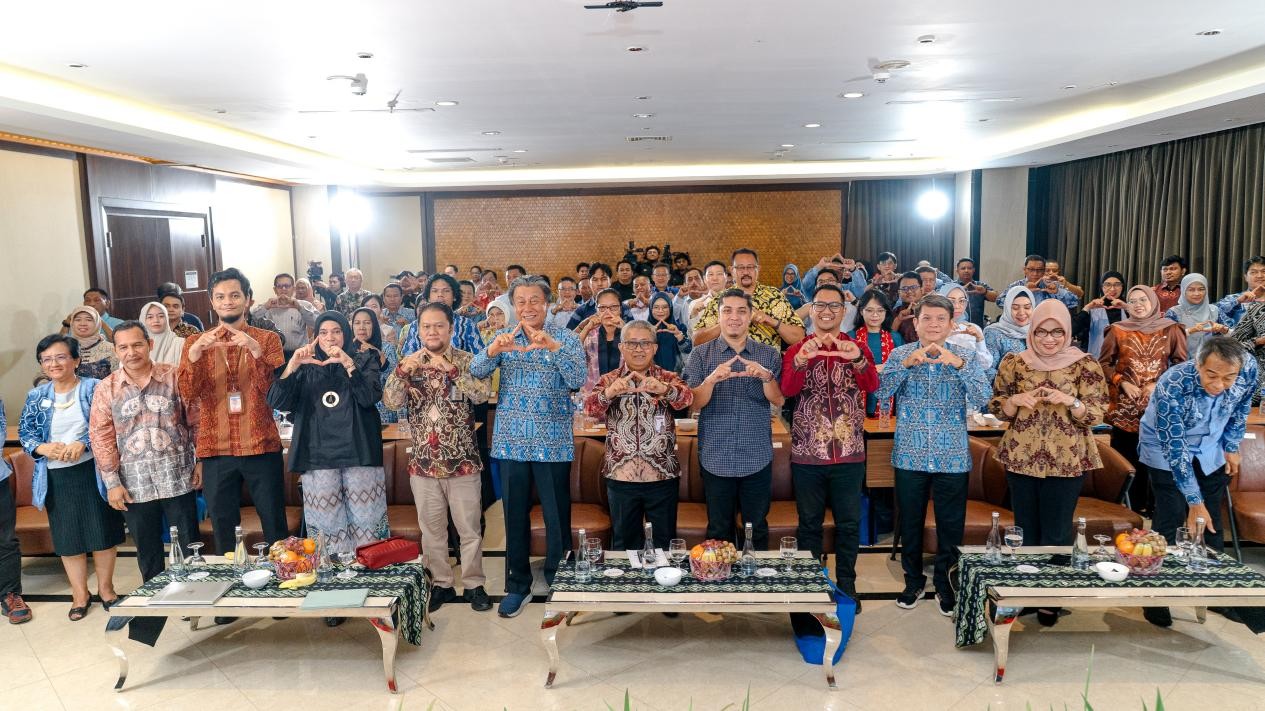
Banjarmasin, April 18, 2026 — Carrying the theme “Advocacy and Collaborative Efforts to Improve the Business Climate,” the South Kalimantan Provincial Board of the Indonesian Employers Association (APINDO) convened its 2nd Provincial Working Meeting (Rakerkonprov II) for 2026. The theme was also the focus of an Economic Dialogue held as part of the meeting’s agenda, which was recorded for broadcast by TVRI South Kalimantan.
The Economic Dialogue and the opening of Rakerkonprov II were attended by representatives from 11 district/city boards (DPK) across South Kalimantan, provincial executives, as well as invited guests from provincial and municipal government institutions, the banking sector, business leaders, academics, labor unions, students, media, and MSMEs. The dialogue featured speakers including Noorhalis Majid, Vice Chair for Organizational Affairs of APINDO South Kalimantan; Mohammad Aly Fikri, an economist from Bank Indonesia; Dr. Ahmad Yunani, Dean of the Faculty of Economics at Lambung Mangkurat University; and Yudhi Mahendra, a regional planning analyst from the South Kalimantan Development Planning Agency (Bappeda).
In his remarks, Noorhalis Majid emphasized the importance of strengthening collaboration among stakeholders to address ongoing economic challenges. He noted that economic growth over the past five years has remained in the range of 5–5.3 percent, a figure that continues to face skepticism, particularly amid global economic uncertainty. He added that while businesses are expected to expand employment opportunities, licensing processes remain complex and burdensome, with bureaucratic hurdles making it difficult and costly to obtain the numerous permits required to establish a single business.
Chairman of APINDO South Kalimantan, Winardi Sethiono, expressed hope that the theme of collaboration would encourage stronger synergy between the regional government, businesses, and labor groups to create a healthy and inclusive business environment. He cited the need to optimize the Online Single Submission (OSS) system to eliminate bureaucratic barriers for investors entering the region.
Representing the Governor of South Kalimantan, Assistant for Economic Affairs and Development Ariadi Noor stated that the forum is expected to serve as a productive platform for discussion and alignment of vision in driving economic growth and business competitiveness. He added that South Kalimantan recorded economic growth of 5.22 percent in 2025, exceeding the national average of 5.04 percent. While this achievement indicates that the region is on the right development track, he stressed the need to accelerate economic transformation toward a more value-added, competitive, and sustainable structure. The provincial government, he said, is committed to positioning South Kalimantan as a logistics gateway for Kalimantan through strategic infrastructure development, human resource improvement, and accelerated investment in priority sectors.
Meanwhile, APINDO National Chairwoman Shinta W. Kamdani, in a recorded video address, underscored that the 2026 Rakerkonprov II represents a strategic momentum to align direction, strengthen roles, and reaffirm the position of the business sector as a key pillar of regional and national economic growth. She noted that the theme of advocacy and collaboration is not only relevant but increasingly urgent amid global uncertainty, geopolitical dynamics, shifting supply chains, and rapid technological disruption. In such conditions, businesses must not only survive but also remain adaptive and responsive to transform challenges into opportunities. This, she stressed, depends fundamentally on a conducive business climate, where advocacy and collaboration play a central role. APINDO must position itself as a strategic partner to the government, not only voicing concerns but also offering data-driven, practical solutions.
Shinta further outlined APINDO’s six priority agendas for 2026. These include strengthening the national labor ecosystem to be more equitable and competitive; advancing strategic policy advocacy through deregulation and licensing simplification; enhancing national trade cooperation to boost export competitiveness; reinforcing flagship programs such as APINDO UMKM Merdeka and Pengusaha Mengajar; expanding APINDO’s regional role through initiatives such as the APINDO Investment Unit; and developing a Family Business Network to strengthen the broader business ecosystem. She emphasized that the success of these agendas depends heavily on the active role of regional APINDO boards, including South Kalimantan, in driving policy advocacy, strengthening collaboration, and ensuring sustainable business growth.
“We must share the same fighting spirit—moving together to strengthen advocacy, expand collaboration, and build a more competitive and sustainable business climate,” she concluded.