APINDO South Kalimantan Attends 35th National Working and Consultation Meeting in Makassar, Calls for Stronger Organization and Business Collaboration
Saturday, 08 August 2026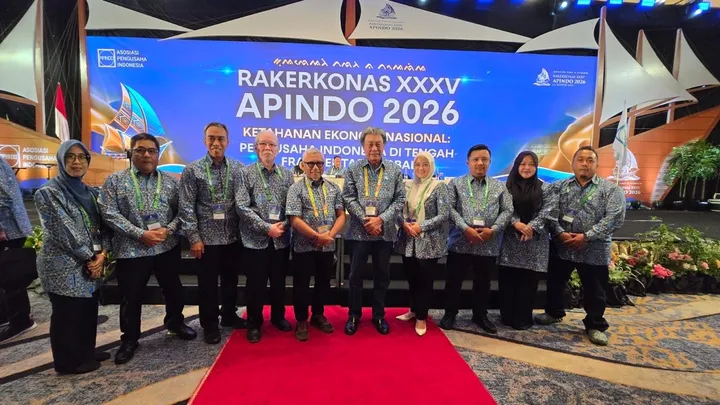
SOUTH KALIMANTAN – The Provincial Executive Board (DPP) of the Indonesian Employers Association (APINDO) South Kalimantan attended the 35th APINDO National Working and Consultation Meeting (Rakerkonas) at Hotel Claro Makassar, South Sulawesi, from August 2–5, 2026.
Chairman of DPP APINDO South Kalimantan Windardi Sethiono attended the event alongside 16 representatives from the APINDO DPK and DPP leadership in South Kalimantan. The Rakerkonas brought together nearly 1,000 business leaders from across Indonesia.
Carrying the theme “National Economic Resilience: Indonesian Entrepreneurs Amid Global Fragmentation,” the event was attended by several Cabinet ministers, the Deputy Speaker and members of the House of Representatives (DPR RI), as well as governors, regents, and mayors. Also in attendance were Indonesia’s 10th and 12th Vice President Muhammad Jusuf Kalla, senior businessman Sofjan Wanandi, and a number of prominent business figures and senior entrepreneurs from across the country.
The Rakerkonas served as a forum to discuss current economic challenges facing the business community, including the impact of national economic policies and global fragmentation on economic growth at the regional level.
In addition to dialogue sessions with ministers and economic experts, the event featured an MSME and business exhibition showcasing a wide range of products and business ventures.
The philosophy of Bugis sailors, who are renowned for their ability to navigate rough seas and their determination not to turn back once the sails are raised, served as a metaphor for the business community’s spirit in facing economic challenges.
“No matter how large the waves are, they must be faced. That is the true spirit of sailors. Entrepreneurs must likewise be able to face every economic challenge and turn it into an opportunity for the advancement of the nation,” APINDO Chairman Shinta W. Kamdani said in her opening remarks.
Meanwhile, Windardi Sethiono said he gained valuable insights from the Rakerkonas. He noted that the various discussions and presentations provided important input for strengthening APINDO South Kalimantan going forward.
One of the key priorities, he said, is the establishment of APINDO Regency/City Executive Boards (DPK) across all regencies and cities in South Kalimantan. This is necessary to ensure that entrepreneurs have an appropriate platform for organization while strengthening collaboration, coordination, and business networks.
“Ideally, all entrepreneurs should become part of APINDO so that we can strengthen one another. If entrepreneurs truly unite, the economy will advance further,” Windardi said.
He explained that APINDO’s focus extends beyond strengthening the business sector to include job creation and advocacy on policies that could hinder business development, including those affecting micro, small, and medium-sized enterprises (MSMEs).
According to Windardi, the current climate of economic uncertainty makes it increasingly important for businesses to have a common platform through which they can address various challenges. Competition facing entrepreneurs is no longer merely local but increasingly global.
Global fragmentation, he said, could have significant implications for the rupiah exchange rate, the supply of goods amid energy crises, as well as the impacts of El Niño, including drought and crop failures. These challenges ultimately affect broader economic conditions.
“By coming together under one organization, entrepreneurs can work together and collectively face even the most difficult circumstances,” he said.
During the commission meetings, Rakerkonas participants also discussed organizational strengthening and APINDO’s 2026–2027 work programs. The forum also formulated a number of recommendations for the government, including the administration of President Prabowo Subianto, to ensure that policies do not place additional burdens on the business community.
Key issues discussed included taxation, business licensing, regulatory reporting, access to capital, bank financing, fuel supplies, and lengthy bureaucratic processes.
Windardi said these challenges could contribute to a high-cost economy, making products produced by Indonesian businesses less competitive in the global market.
“APINDO wants to stand alongside entrepreneurs in facing these challenges. This Rakerkonas is part of our consultation process, enabling entrepreneurs to collectively develop the capacity to overcome these challenges,” Windardi Sethiono concluded.
Source: kalsel.pikiran-rakyat.com