DPP APINDO North Sumatra Holds Provincial Working and Consultation Meeting, Discusses National Economic Developments
Wednesday, 12 August 2026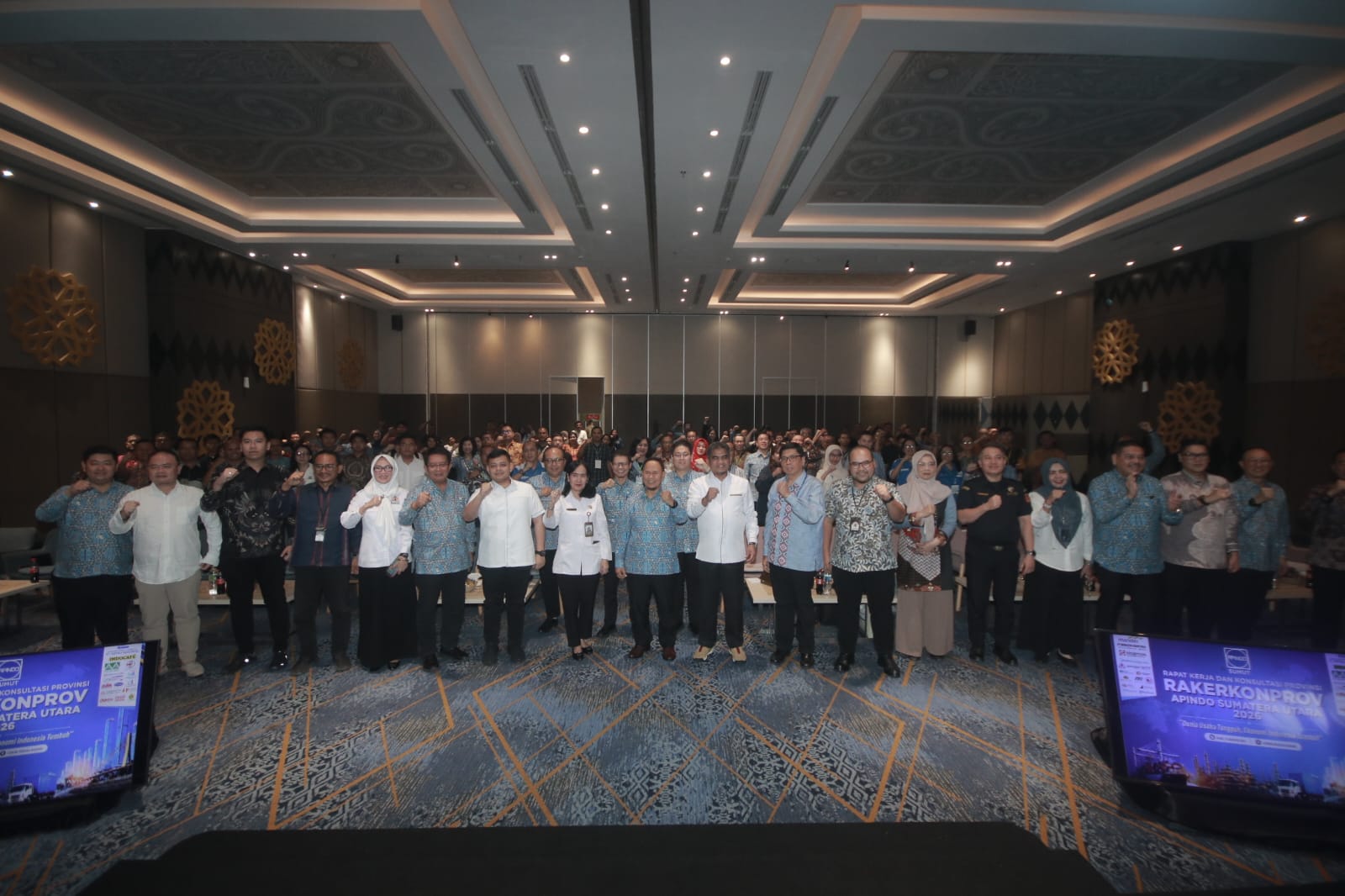
MEDAN, August 12, 2026 – The Provincial Executive Board (DPP) of the Indonesian Employers Association (APINDO) North Sumatra convened its Provincial Working and Consultation Meeting (Rakerkonprov) in Medan on Wednesday (August 12, 2026). The meeting served as a forum for organizational consolidation while addressing national and regional economic developments and various challenges facing the business community.
The event also featured the inauguration of the DPK APINDO Serdang Bedagai and DPK APINDO Batu Bara for the 2025–2030 term, as well as DPK APINDO Padangsidimpuan and DPK APINDO South Tapanuli for the 2026–2031 term. The agenda also included an Economic Dialogue featuring APINDO Economic Policy Analyst Ajib Hamdani, as well as a briefing on Minister of Law Regulation No. 49 of 2025 concerning the Requirements and Procedures for the Establishment, Amendment, and Dissolution of Limited Liability Companies. The event concluded with a plenary session and commission meetings.
Representing APINDO Chairman Shinta W. Kamdani, DPN APINDO Head of Organization Affairs Anthony Hilman expressed his appreciation for the organization of the Rakerkonprov by DPP APINDO North Sumatra. He said the forum provided an important opportunity to translate the outcomes of the APINDO National Working and Consultation Meeting (Rakerkonas) in Makassar into agendas and priorities aligned with the needs of the regional business community.
According to Anthony, North Sumatra holds a strategic position as one of the gateways to western Indonesia. The presence of Belawan Port, Kuala Tanjung Port, Kualanamu International Airport, the Medan Industrial Estate, and the Sei Mangkei Special Economic Zone (SEZ) provides a strong foundation for trade and industry, particularly given North Sumatra’s location along the Malacca Strait and its direct access to ASEAN markets.
“This means North Sumatra is not merely a commodity-producing region. It is an important part of Indonesia’s trade and industrial supply chains,” said Anthony, who was accompanied by APINDO Executive Director Rudolf Saut.
Nevertheless, Anthony noted that a number of challenges remain and require collective attention. In 2026, the number of unemployed people in North Sumatra stood at approximately 408,000, with an open unemployment rate of 5.01 percent. Meanwhile, informal employment continued to dominate the labor market, accounting for approximately 4.48 million workers, or 57.91 percent of the total employed population.
“Economic growth cannot stop at headline figures. Growth must translate into more productive jobs, stronger businesses, and broader economic opportunities,” he stressed.
During the Economic Dialogue at the 2026 Rakerkonprov of DPP APINDO North Sumatra, APINDO Economic Policy Analyst Ajib Hamdani and Special Staff to the Minister of Manpower Indra, S.H., M.H., discussed the economic outlook and challenges facing the business sector.
Ajib Hamdani highlighted that the national economy continues to grow above the five-year trend, but the key challenge now lies in the weak transmission of economic growth to the real sector. The recovery of several manufacturing indicators needs to be sustained amid increasingly complex external pressures, ranging from escalating geopolitical tensions and rising energy and raw material prices to supply chain disruptions and exchange-rate volatility.
These pressures have increasingly affected household purchasing power and consumer activity. The Real Sales Index remained in contraction territory, declining by 4.4 percent in June 2026, while the Consumer Confidence Index fell from 127 in January to 116.8 in July 2026. Meanwhile, the weakening rupiah, which at one point breached Rp18,000 per U.S. dollar, increased the cost of imported raw materials, capital goods, logistics, and foreign-currency obligations, while potentially constraining business investment and expansion.
Ajib also highlighted the industrial sector’s continued dependence on imported raw materials. Several strategic commodities, including refined sugar, industrial salt, food-grade corn, and soybean meal, still face limited domestic substitutes in terms of quality, quantity, supply continuity, and technical specifications. This condition demonstrates that strengthening national industry requires more than simply expanding production capacity; it also requires strengthening upstream sectors and supply-chain resilience.
At the domestic level, high business costs and bureaucratic complexity remain structural barriers to competitiveness. Logistics costs account for 14.29 percent of GDP, while industrial electricity prices are 32 percent higher than in Vietnam. Lending rates of 8–14 percent also remain above the ASEAN-5 average. These cost pressures have become increasingly significant as wage growth between 2014 and 2025 outpaced both inflation and GDP growth.
In response, businesses need to move beyond merely surviving and instead build greater business resilience. Through its “SURVIVE” framework, APINDO encourages businesses to strengthen cash flow, improve operational efficiency, reposition market strategies, reinforce supply chains, invest in appropriate technology, develop human resources, and expand strategic collaboration.
On the policy front, the government needs to balance short-term responses to economic volatility with a long-term agenda to strengthen economic fundamentals. Priorities include maintaining energy-price and exchange-rate stability, ensuring the smooth flow of logistics and supply chains, strengthening domestic consumption and providing targeted stimulus for labor-intensive industries, reducing the high cost of doing business, pursuing deregulation and debottlenecking, and strengthening domestic energy resilience and upstream industries to reduce dependence on imports.
Synergy among the government, business community, and society remains critical to ensuring that global pressures do not develop into prolonged economic weakness.