APINDO Bekasi Regency Holds Discussion on Employment Protection Bill Approved by House of Representatives
Thursday, 15 October 2026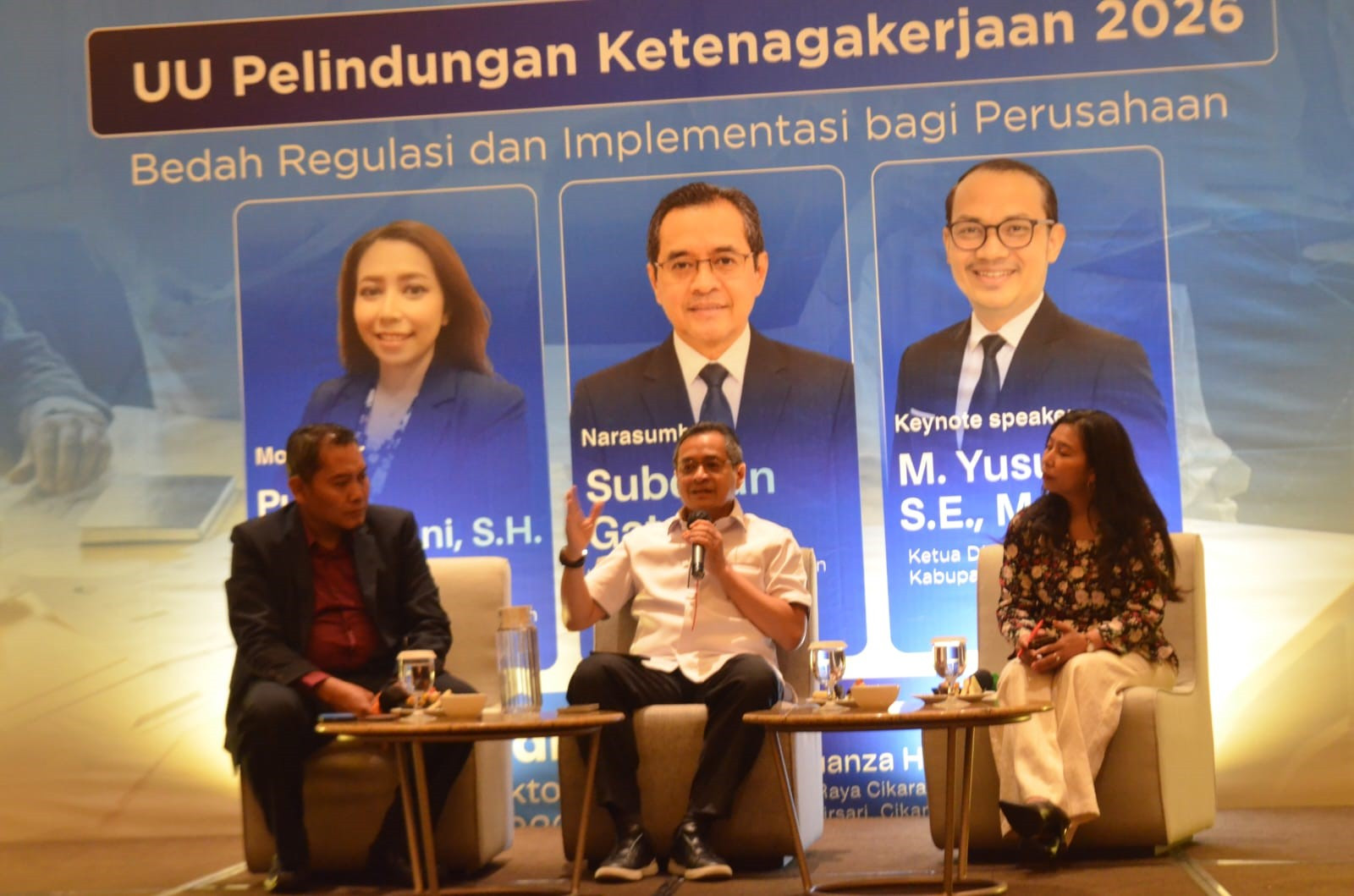
CIKARANG, WEST JAVA — The Bekasi Regency Board of the Indonesian Employers Association (DPK APINDO Kabupaten Bekasi) held a discussion on the Employment Protection Law at Nuanza Hotel in South Cikarang on Thursday, October 15, 2026. The event was attended by 216 business representatives, including both APINDO members and non-members.
Several DPK APINDO Bekasi Regency officials attended the event, including Dewi Kristiani, Deputy Secretary; Herman Supratman, Head of the Small and Micro Enterprises Division; and Boy Chaidir Rosman, Head of the Education, Training, and Productivity Division, along with other board members.
The discussion covered regulatory developments, APINDO's input during the drafting process, and the potential implications for companies and industrial relations.
Participants showed strong interest during the question-and-answer session, actively raising questions and sharing perspectives on challenges faced by businesses. Topics included wage structures and scales, fixed-term employment agreements (Perjanjian Kerja Waktu Tertentu or PKWT), severance pay, and pension benefits.
The session provided business representatives with an opportunity to seek clarification directly from the speakers and gain a better understanding of key issues under consideration in the formulation of employment regulations.
In his opening remarks, M. Yusuf, Chairman of DPK APINDO Bekasi Regency, expressed hope that the presentations would serve as a useful reference for participants in understanding the latest developments in employment regulations.
"Today, Mr. Subchan will share information that will certainly serve as a reference for us in understanding how far the Employment Protection Law has progressed," Yusuf said.
He also expressed hope that the President would assess employment issues objectively by considering different perspectives rather than relying on information from a single party.
"I hope the President will take into consideration the importance of viewing the situation objectively, rather than hearing only one side of the story," he added.
The event continued with a presentation by Subchan Gatot, Chairman of the Wage Committee under the Employment Affairs Division of APINDO's National Board (DPN APINDO). He discussed developments in the drafting of the Employment Protection Law and APINDO's recommendations concerning job creation, workforce skills development, wages, social security, and stronger industrial relations.
Subchan emphasized that the final text of the proposed regulation had not yet been officially released at the time of the discussion, as the drafting process was still undergoing refinement.
"As of today, not a single article has been officially released," he explained.
Consequently, the discussion also addressed APINDO's proposals and developments in the dialogue surrounding the drafting process.
He further outlined APINDO's involvement, alongside the Indonesian Chamber of Commerce and Industry (Kadin), in submitting recommendations on employment regulations. These proposals covered several key areas, including job creation, workforce skills development, alignment between social security and taxation policies, regulatory compliance, enforcement, and productivity.
Subchan stressed that job creation remained one of APINDO's primary priorities in providing input on the proposed legislation.
"We want to see the creation of new jobs," he said.
According to him, employment regulations should help foster a business environment in which companies can grow and generate more employment opportunities.
He explained that APINDO's recommendations extended beyond employment relationship provisions to include policies supporting improvements in workforce competencies. One of the proposals discussed was the Skill Development Fund, an initiative related to workforce skills development.
From a legal advocacy perspective, Tatang Sutarman, a legal advocate representing APINDO Bekasi Regency, highlighted the challenges businesses face in maintaining legal certainty when employment regulations change. He cited the experiences of companies and human resources (HR) teams in adjusting collective labour agreements (PKB) and company regulations to comply with applicable laws.
"Does this country provide legal certainty, or is the law itself uncertain?" Tatang asked, reflecting concerns that arise when companies have already aligned their internal policies with existing regulations but subsequently face further regulatory changes.
Tatang also addressed several provisions that warrant attention in discussions on employment regulations, including fixed-term employment agreements (PKWT), outsourcing, and apprenticeship programs. He explained that provisions governing eligible types of work and their implementation must be carefully understood, as non-compliance could have implications for employment status.
Through this discussion, APINDO Bekasi Regency encouraged companies to stay informed about developments in employment regulations and prepare for the provisions that will ultimately be enacted. The forum also provided business representatives and HR practitioners with an opportunity to discuss industrial relations challenges and develop a shared understanding amid the ongoing refinement of the regulatory framework.
Source: Jurnal Kawasan